
| Published August 13, 2026 | Updated August 18, 2026 with full SMDRA and CAR data. |
DENVER MARKET REPORT | August 2026
What the Numbers Actually Mean for You
By Brian Trampler | Corcoran Perry & Co.
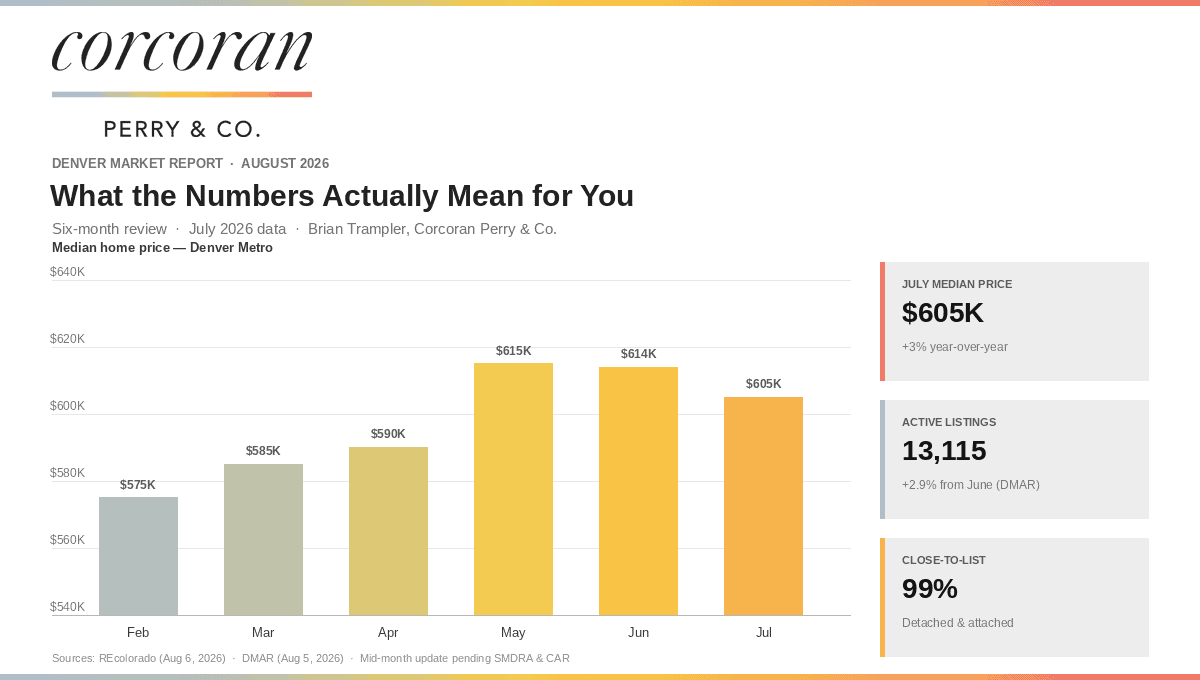
July gave us a market that is settling into its summer rhythm, and the story isn't dramatic. It's patience.
Homes took longer to sell in July than they did in June, and that's now three months running. Prices are still higher than they were a year ago, but they eased slightly from June's numbers. New listings and pending sales both cooled off from the pace we saw earlier in the summer.
None of this means the market stalled. It means buyers have more room to think, and sellers have to work a little harder to earn a serious offer. REcolorado and DMAR data both point the same direction this month, which tells me the trend is real and not just noise in one data set.
If you've been waiting for a sign that the frantic pace of the past few years is behind us, July is another data point in that direction.
The Snapshot
July in Denver Metro, at a glance:
Median closed price: $605,000, up 3 percent from last July, down 2 percent from June
Homes sold: 3,669, down 2 percent from last July, down 9 percent from June
Days on market: 22 days, up from 19 in June. Third straight monthly increase, though still 4 days faster than last July
New listings: 5,450, up 2 percent from last July, down 5 percent from June
Pending sales: 3,440, down 3 percent from last July, down 6 percent from June
Active inventory: about 15 weeks of supply, down 4 percent from last July
Sellers received: about 99 percent of asking price on average
Rental market: median lease price $2,850, up 2 percent from last July, though 11 percent fewer homes were leased
Put together, this is a market where prices are holding but pace is slowing. That combination tends to reward sellers who price accurately from day one and buyers who don't feel rushed.
If You're Buying
Three months of rising days on market is worth paying attention to. It means you have more time to think through a decision, more room to ask for what you need, and less pressure to waive things you shouldn't waive.
Prices are still up from a year ago, so waiting indefinitely isn't a strategy either. What's changed is the math around timing. A home that would have needed an offer within 48 hours a year or two ago might sit for two or three weeks now, especially if it's priced even slightly aggressively.
Rates are still sitting in the mid 6 percent range, and that's not likely to shift dramatically in the near term. Build your plans around where rates are today, not where you hope they'll be in six months.
If you've been sitting on the sidelines because the market felt too fast to make a clear decision, July's numbers suggest that pressure has eased. You still need to move when the right home shows up, but you don't need to move blind.
The question worth asking yourself: if a home you loved took three weeks to sell instead of three days, would that change how you're approaching your search?
If You're Selling — or Trading Up
Pricing accuracy matters more this month than it did in June. Days on market climbing for a third straight month means buyers are taking their time to compare, and a home that's priced even a little high will sit long enough for buyers to notice.
The good news is sellers are still netting close to full asking price, about 99 percent on average. That tells me buyers aren't looking for a discount so much as they're looking for confidence that the price is fair. Get the number right at listing, and you're still in a strong position.
If you're thinking about trading up, the math is a little more forgiving than it's been in a while. Your current home is likely worth more than it was a year ago, and the home you're moving into isn't appreciating any faster than yours is. That gap doesn't close on its own, but it also isn't working against you the way it can in a hotter market.
For those who've been putting off a move because it felt like bad timing, July doesn't change the fundamentals. It just asks you to be a little more deliberate about pricing and a little more patient about the process.
The question worth asking yourself: is the home you're in still the right fit, or are you staying because moving feels harder than it actually is?
The Local Angle
Denver Metro's summer has followed a pretty predictable script this year. Activity built through spring, peaked around May and June, and is now easing the way it typically does once the calendar turns to August and families start thinking about the school year instead of moving trucks.
Rates in the mid 6 percent range continue to be the biggest single factor shaping decisions on both sides. Buyers are qualifying for less than they might have a few years ago, and sellers with a lower rate on their current mortgage are still weighing whether a move is worth giving that up. That tension isn't new, but it's still the quiet force behind a lot of the hesitation we're seeing.
The rental market is worth a look if you're an investor or watching from that angle. Lease volume is down about 11 percent from last July, but the median lease price is still up 2 percent. Fewer transactions, firmer pricing. That combination usually means renters are being more selective, not that demand has disappeared.
For anyone relocating into Denver from Colorado Springs or elsewhere on the Front Range, this is a market with more room to negotiate than you might expect if you're coming from a tighter market. That's especially true in the outer suburbs, where inventory has had more time to build.
We'll have a fuller picture of the south metro counties and city-level breakdowns once SMDRA and CAR data publish around mid-month. That update will go right below this post.
July confirmed what June suggested: this market is settling into a steadier, more seasonal pattern instead of racing ahead or falling off a cliff. That's not a headline, but it's useful information if you're trying to plan a move.
MID-MONTH UPDATE — AUGUST 18, 2026
SMDRA's seven-county south metro numbers landed this week, and they line up with what REcolorado and DMAR already showed. Median price came in at $600,260, up 2.3 percent from last July. Closed sales and pending sales both eased a bit, the same softening pace we saw across the metro overall.
CAR's numbers for the four-county core, Arapahoe, Douglas, Jefferson, and Denver, add a wrinkle worth flagging. Active listings in that core dropped 15.9 percent from a year ago, a much steeper decline than the roughly 4 percent pullback REcolorado reported for the metro overall. The center of the market is tightening faster than the edges.
That shows up clearly at the city level. Highlands Ranch, Castle Rock, Centennial, and Wheat Ridge all posted price gains between 2 and 6 percent, with days on market falling in every one of them. Wheat Ridge stood out the most: inventory there is down 45 percent from last July, tighter than almost anywhere else in the data.
If you're one of the Front Range buyers looking at Denver from the outside, this is useful context. The close-in suburbs are getting harder to find room in. The outer ring still has more give.
Put together, July confirmed the slowdown story from the early read, and added a layer underneath it. It isn't happening evenly across the metro. Close-in supply is thinning out while farther-out suburbs still have breathing room.
— Brian











Socials