
DENVER MARKET REPORT | MAY 2026
What the Numbers Actually Mean for You
By Brian Trampler | Corcoran Perry & Co.
PUBLISHING NOTE
Published May 6, 2026 | Updated May 13, 2026 with full DMAR, SMDRA, and CAR April data.
March felt like a turning point. Then April showed up.
After a 30% surge in pending sales in March — the strongest month-over-month jump in over a year — April pumped the brakes. Pending listings dipped about 2% from March. New listings kept climbing, up more than 18% compared to this time last year. Mortgage rates, which had briefly touched below 6% in late February for the first time since 2022, climbed back into the mid-6% range and stayed there.
So which month told the real story — March's breakout or April's hesitation?
Probably both. Here's what the data actually means, depending on where you stand.
The Snapshot: April 2026
The DMAR April report dropped this week. Here's the picture across multiple sources:
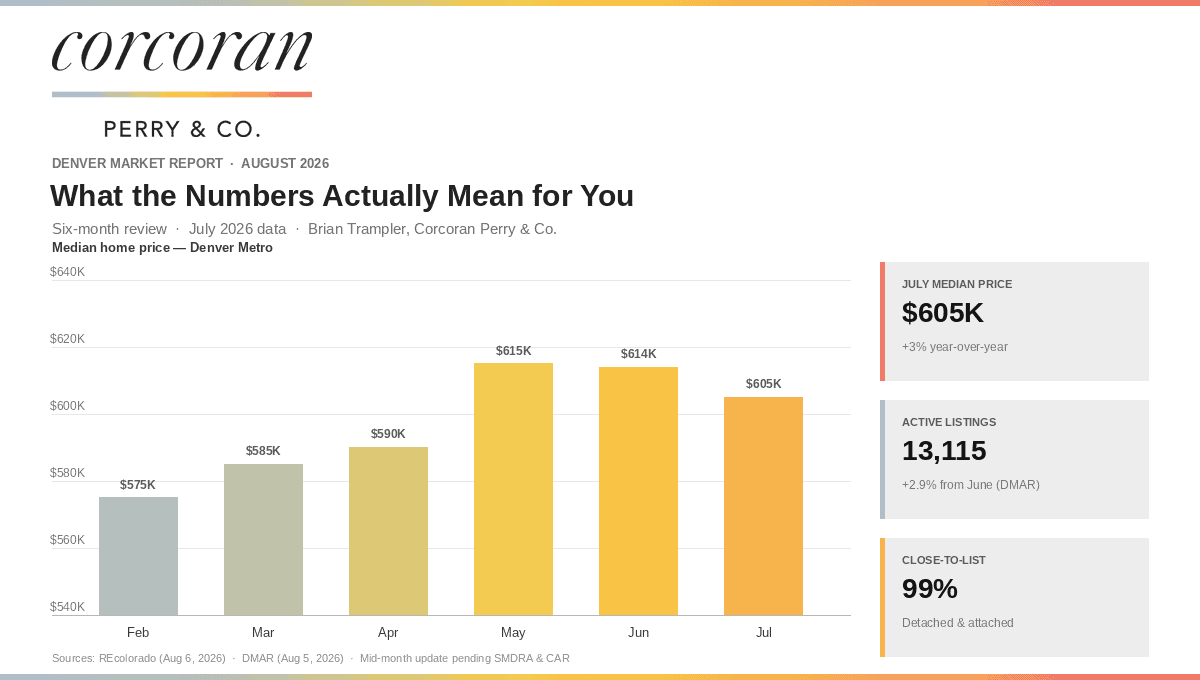
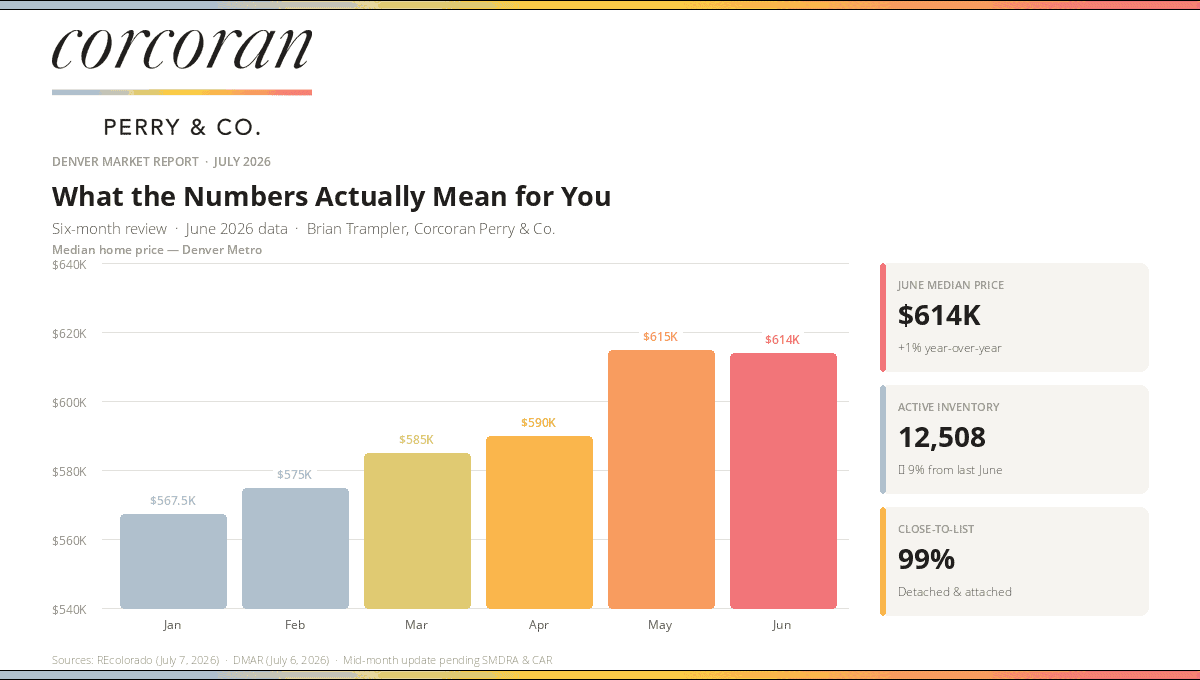
Median closed price: ~$590,000 — holding flat in a narrow band it's occupied since May 2025
New listings: Up 18%+ year-over-year — sellers are coming to market
Pending sales: Down 2.27% from March — buyers took a breath after the spring surge
Close-to-list ratio: 99.4% — well-priced homes are still trading near ask
Year-to-date closed sales: Down 5.04% vs. 2025 — cumulative volume is still lagging
Two things are true simultaneously right now: the market is more active than it was six months ago, and it's more cautious than March made it look. That's not contradiction — that's spring in Denver.
One new variable worth watching: tariffs on steel, aluminum, and lumber are adding more than $9,200 to the cost of each new home built in Colorado. That's starting to push some buyers away from new construction and back toward resale — which matters if you're a seller competing for that audience.
If You're Buying
April was actually a better month to buy than March, even though it felt quieter. Less urgency means more time to think. More inventory means more choices. The frantic weekend-offer chaos that defined 2021 and 2022 is largely gone — and for a first-time buyer who never got to participate in a normal market, that's worth something.
The rate environment is frustrating, but it's not going to surprise anyone anymore. What I'm seeing is buyers who've recalibrated — they're not waiting for a 5% rate, they're buying when the right house at the right price shows up. That's the right frame.
One thing worth understanding: the gap between median days on market (15-17 days for well-priced homes) and average days on market (closer to 36) tells you everything about this market. Priced-right homes still move fast. Overpriced homes sit and eventually cut. If you find a home that's been sitting, there's a conversation to be had. If you find one that just listed at a sharp price, don't assume you have time.
The question worth asking yourself: Am I waiting for the perfect conditions, or am I waiting to feel more ready?
If You're Selling — or Trading Up
The DMAR Market Trends chair said it plainly in this month's report: listings must now earn buyer attention through preparation, realistic pricing, and compelling presentation. That's not pessimism — it's just the current truth.
The close-to-list ratio at 99.4% sounds great until you realize what's underneath it: sellers who held their headline price are increasingly absorbing costs through rate buydowns, repair credits, and concessions at closing. More than 63% of sellers offered some form of concession in March — up nearly 4% year-over-year. The negotiation has moved off the list price and into the deal terms. Smart sellers know this. Sellers anchored to 2022 peak expectations are the ones sitting at 40+ days.
For the seasoned mover — someone right-sizing, relocating, or finally making the trade they've been sitting on — the math is more favorable than the headlines suggest. Single-family homes are holding better than attached properties. If you're in a well-maintained single-family home in an established Denver neighborhood, you're in a different market than someone trying to move a condo right now.
The attached market — condos and townhomes — is the stressed segment. HOA costs are climbing (partly because of Denver Water's drought-driven maintenance increases), insurance premiums are up, and buyers have leverage they haven't had in years. If you're selling attached, price it for today's market, not last year's.
The question worth asking yourself: Is the price I want based on what my home is worth today, or what I wish it was worth?
The Local Angle
A few things are happening in Denver that don't show up in the metro-wide numbers:
The drought situation is real, and it's starting to affect real estate decisions. Denver Water's Stage 1 restrictions are raising HOA operating costs for common area maintenance on attached properties — that's a direct hit to condo affordability that wasn't a factor a year ago. If you're buying or selling a property with shared outdoor space, this is worth factoring into your numbers now.
Denver and Arapahoe counties are seeing population shifts — residents moving toward Weld, Douglas, and Larimer counties, or leaving Colorado entirely. That's a slow-moving story, but it's shaping where demand is concentrating. The inner-city neighborhoods and established suburbs closest to employment corridors are holding better than the outer-edge markets.
New construction is getting more expensive before it gets cheaper. Tariffs are real, they're being passed through, and builders are not absorbing the full cost. If you have a client weighing new construction against resale, that conversation just got more interesting in favor of resale.
March asked whether this spring would be a turning point. April said: Maybe, but not yet. The full picture will be clearer mid-month when the complete metro data comes in — and I'll update this post when it does.
MID-MONTH UPDATE — MAY 13, 2026
Three sources — DMAR, SMDRA, and CAR — all published their full April data this week. Here's what it confirmed, and where it adds nuance to the early read above.
The headline held. Across the 4-county core market, total closed sales came in at 3,075 — essentially flat year-over-year — and the overall median dipped just 0.3% to $625,199. The market didn't surge and it didn't fall. Going into summer, that steadiness is actually the story.
The single-family picture is cleaner than the early read suggested. Under-contract activity jumped 11.2% year-over-year, and the median held at $697,000 — flat from a year ago and trading at 99.5% of list price. That segment is absorbing buyers at a healthy pace.
The attached market confirmed what the early numbers hinted at. Condo and townhome days on market climbed 17% year-over-year to 55 days, and the close-to-list ratio slipped to 98.5%. Those aren't alarming numbers on their own — but the direction has been consistent for several months now. Buyers in that segment have real leverage.
The geographic story is the most useful new data. The SMDRA 7-county report — which adds Adams, Broomfield, Douglas, and Elbert counties to the mix — showed the median holding at $600,000 with pending sales up 7.9% year-over-year. Dig into the CAR city-level numbers and the south metro stands out: Centennial under-contracts up 19%, Highlands Ranch closed sales up 19%, Wheat Ridge single-family under-contracts up 21%. The outer suburbs are absorbing demand that isn't finding what it needs closer in.
The one thing that shifted from the early read: new listings tightened. New listings across the 4-county market fell 5.5% year-over-year — the opposite of what March suggested was coming. Sellers came out in March, took a breath in April, and the inventory expansion that looked inevitable hasn't fully arrived. For buyers, well-priced homes in good condition are still moving fast. For sellers, there's less competition than you might expect.
Going into June, the two-track market continues: single-family steady, attached resetting, south metro quietly outperforming. Which track you're on matters more than the metro average.











Socials