
DENVER MARKET REPORT | June 2026
What the Numbers Actually Mean for You
By Brian Trampler | Corcoran Perry & Co.

Here's something that doesn't get said enough: a market can be slow and healthy at the same time.
May confirmed that. Transaction volume is down year-over-year. Rates are still above 6%. DMAR's own summary says higher mortgage rates are sidelining buyers and sellers. And yet — median prices are up 3%. Pending sales are up 5%. Days on market is holding at 15-16 days for the metro. Sellers who priced correctly are still trading near ask.
The people transacting in this market are doing so because life required it. And they're doing fine. That's the real story of May 2026.
Here's what the numbers mean, depending on where you stand.
The Snapshot: May 2026
Three sources — REcolorado, SMDRA, and CAR — all published May data this week. They're measuring slightly different county footprints but telling the same story:
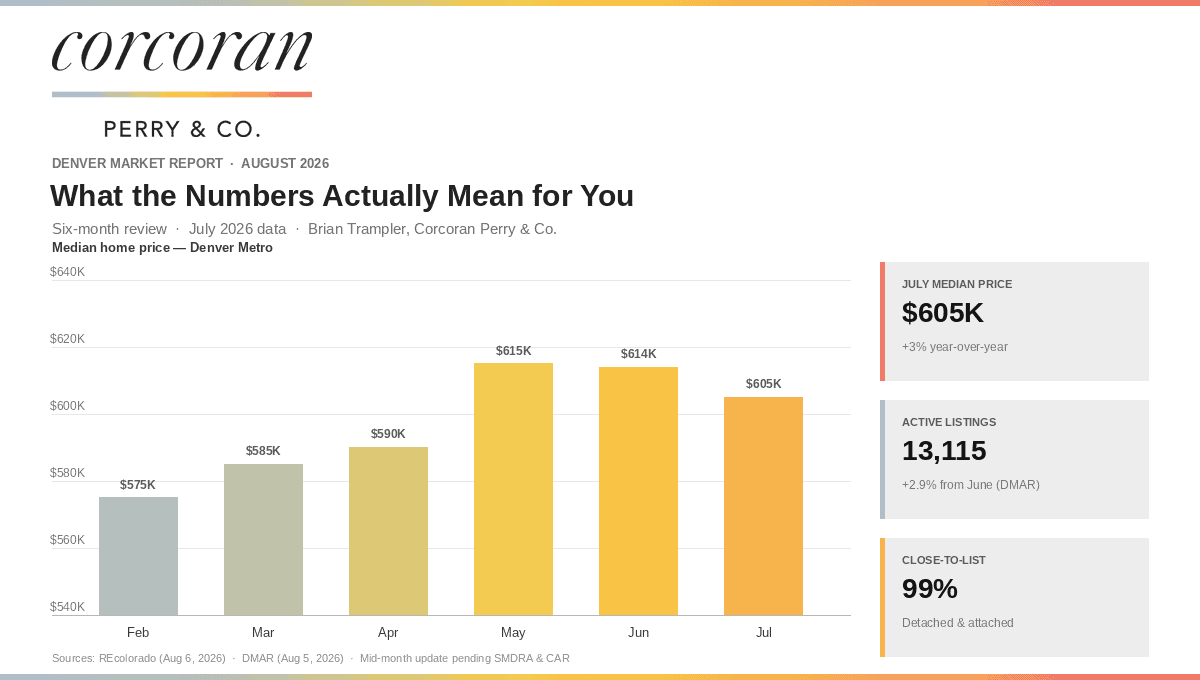
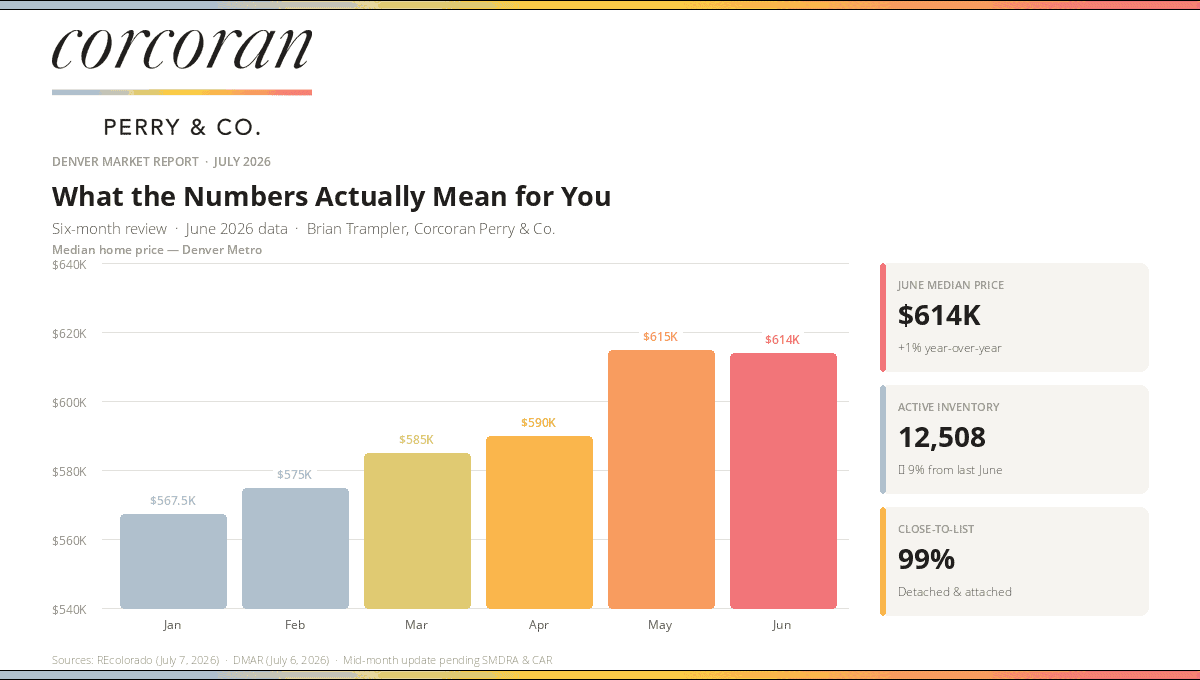
Metro-wide median price: $612,750–$615,000 — up 3% year-over-year across all three sources
Single-family median: $710,000 — up 1.4% year-over-year, up from $700,000 in May 2025
Condo/townhome median: $395,000 — down 1.3% year-over-year; the only segment where prices are slipping
Pending sales: Up 5% year-over-year — buyers are moving, just selectively
New listings: Down 17–18% year-over-year — the supply story is the headline this month
Median days on market: 15–16 days metro-wide; 32 days for single-family, 55 days for attached
Months of supply: 2.9 — technically still a seller's market
Close-to-list ratio: 99.6% single-family / 98.5% condo-townhome
The supply drop is the number that changes everything else. New listings fell nearly 18% year-over-year. That's not a blip — it's sellers staying put, either because they're locked into low rates, uncertain about what comes next, or simply not ready. Fewer listings with steady buyer demand is the textbook formula for price stability and upward pressure. We're seeing both.
If You're Buying
The 18% drop in new listings is the number to pay attention to if you're a buyer. It means less inventory to choose from — and it means the homes that are priced right are still moving in two weeks. The days where buyers had six months of inventory to browse through and take their time are not this market.
That said, this isn't 2021 either. Median days on market for single-family is 32 days — double what it was three years ago. You have more time to think and more room to negotiate than buyers did at the peak. The attached market, with 55 days on market and a close-to-list ratio that's slipping, gives buyers real leverage that simply didn't exist before.
For someone relocating from Colorado Springs or another Front Range market, the Denver metro at $612,750 median feels expensive — but the city-level data tells a more useful story. Aurora single-family median is $522,000. Arapahoe County is $615,000. Lakewood is $731,000. The range is wide, and the right answer depends entirely on where you need to be and what you need in a home. The $250–350K range exists in Denver — it's mostly condos and townhomes, and that market is softer right now, which means buyers have negotiating room they haven't had in years.
The question worth asking yourself: Do I have a clear picture of what's actually available in my price range right now, or am I still working from assumptions I formed six months ago?
If You're Selling — or Trading Up
The supply drop works in your favor — but only if you price correctly from the start.
A 99.6% close-to-list ratio on single-family homes sounds like every seller is winning. But that number is an average. The homes pulling that average up are priced accurately for today's market, presented well, and going under contract in under three weeks. The homes dragging it down are sitting at 40, 50, 60 days and eventually cutting. Those two realities are both true simultaneously.
Some specific city data worth knowing: Castle Rock single-family median climbed 4.5% to $768,000, with closed sales up 14% — one of the stronger markets in the metro right now. Centennial closed 18% more single-family homes than a year ago. Denver County single-family median hit $710,000, up 1.1%. These aren't distressed markets. Sellers in these areas are transacting well when priced correctly.
The attached market is a different conversation. Condo and townhome days on market hit 55 days in May — up 25% year-over-year. The median dropped to $395,000, down 1.3%. If you're selling attached, the buyer in front of you knows they have options and time. Concessions, pricing flexibility, and preparation matter more in this segment than anywhere else right now.
For the seasoned mover — someone right-sizing, relocating, or making the trade they've been sitting on — the math is still favorable. You're selling and buying in the same market. The spread matters more than the absolute numbers, and that spread hasn't moved dramatically against you.
The question worth asking yourself: Is my list price based on what similar homes are selling for today, or what I wish they were selling for?
The Local Angle
A few things worth watching that don't show up in the metro-wide numbers:
The supply drop has a structural explanation that's not going away. Roughly a third of Denver metro homeowners have a mortgage rate below 3.5%. At 6%+ rates, moving means giving that up and taking on a significantly higher monthly payment — often $800–1,200 more per month on the same price home. That math is keeping a lot of would-be sellers in place. Until rates drop meaningfully or life forces the move, this supply constraint is part of the landscape.
The Front Range migration pattern continues. The data from Arapahoe County (under contracts up 14.8% YTD) and Castle Rock (closed sales up 15.1% YTD) suggests buyers moving northward from Colorado Springs and southward from the urban core are increasingly landing in the southern and southeastern suburbs. If you're working with clients in that transition, the Douglas and Arapahoe county markets are where the action is.
Summer is the slower half of the year, and that's not a problem — it's predictable. July and August traditionally soften as families shift focus to back-to-school. If you're thinking about listing, the window between now and July 4 gives you the strongest buyer pool of the summer. After that, you're competing with fall inventory. Neither is bad; they're just different timelines.
One more note for anyone watching the rental market: REcolorado data shows median rent in the Denver metro dropped 4% year-over-year to $2,798, and rental transaction volume fell 13%. If you're on the fence between buying and renting while you look, the rental market is softer than it's been in several years, which gives you more runway to be selective.
May was the clearest month yet in terms of what the numbers mean for you. Three sources, consistent numbers, a coherent story: supply is tight, buyers are steady, single-family is holding, and attached is resetting. If you know which segment you're in, you know what to do. If you're not sure, that's the conversation worth having.










Socials